
trademarking
What Every Entrepreneur in Nigeria Should Know About Trademarks Before It's Too Late.

Encirco
02 Jul 2026 • 10 min read

One of the biggest misconceptions among entrepreneurs is believing that creating a business name automatically means owning it. You came up with the idea. You registered your company with CAC. You bought the domain name. You secured the Instagram handle. Your logo is everywhere. It feels like the brand is yours. Legally, however, those things don't necessarily mean you own the rights to use that brand commercially.
Contents
That's because building a brand and protecting a brand are two completely different things. One requires creativity, consistency, and years of hard work. The other requires intellectual property protection. Unfortunately, many entrepreneurs don't discover the difference until someone objects to their brand, copies it, or forces an expensive rebrand after they've already built recognition.
Let's clear up the biggest misconception first: registering your business with the Corporate Affairs Commission (CAC) is not the same as registering a trademark. CAC registration creates a legal business entity. A trademark protects your brand identity. They're both important, but they solve entirely different problems. One allows you to operate a business. The other helps protect the identity customers associate with that business.
A trademark protects what makes your business recognizable—your brand name, logo, slogan, and sometimes even distinctive product names. It's what separates your business from every other business in the market. Without trademark protection, someone else could use a confusingly similar name or identity, benefiting from the trust and reputation you've spent years building.
This matters even more in today's digital economy. Businesses grow faster than ever through social media, online marketplaces, and digital products. Unfortunately, brands can also be copied faster than ever. It only takes one similar-looking business to confuse customers, dilute your reputation, or divert opportunities that should have been yours. Trademark protection isn't simply about legal paperwork. It's about protecting one of your most valuable business assets.
It's equally important to understand what a trademark doesn't do. Registering a trademark doesn't stop competitors from entering your industry. It doesn't prevent someone from building a similar product. It doesn't protect business ideas or concepts. It doesn't guarantee commercial success. A trademark protects your identity—not your entire business.
One area many entrepreneurs overlook is trademark classes. Trademarks are registered within specific classes of goods and services, based on an internationally recognized classification system. This means protection isn't simply attached to a name; it's attached to the categories in which that name is used. For example, a software company, a clothing brand, and a restaurant could face very different trademark considerations even if similar names exist.
This is particularly important for technology businesses. If you're building SaaS products, mobile applications, AI platforms, fintech solutions, or developer tools, understanding which trademark class your products or services fall under is just as important as choosing the right technology stack. It's not only a legal consideration; it's a business decision that affects how your brand is protected as your company grows.
Another common misconception is timing. Many entrepreneurs postpone trademark registration until they become successful. Ironically, that's often when they become most vulnerable. Once customers recognize your brand, you've created something worth copying. Waiting until then means you're protecting your reputation after you've already exposed it.
The cost of delaying protection is rarely just legal fees. Imagine changing your business name after five years. Your website changes. Your packaging changes. Your social media handles change. Your marketing materials change. Your customers become confused. Search rankings disappear. Brand recognition starts from scratch. Suddenly, what seemed like a small administrative task becomes one of the most expensive business decisions you'll ever make.
The good news is that entrepreneurs don't have to navigate trademark registration alone. While the process involves availability searches, classification, filing, examination, publication, and registration, it shouldn't distract business owners from doing what they do best—building companies. The right guidance makes the process significantly simpler and helps entrepreneurs avoid costly mistakes before they happen.
That's exactly where Encirco comes in. Encirco helps entrepreneurs protect what they're building by simplifying the trademark registration process from start to finish. Whether you're trying to determine if your brand is available, identify the appropriate trademark class, understand what can actually be protected, or complete your registration correctly, Encirco provides the guidance needed to make informed decisions without unnecessary complexity.
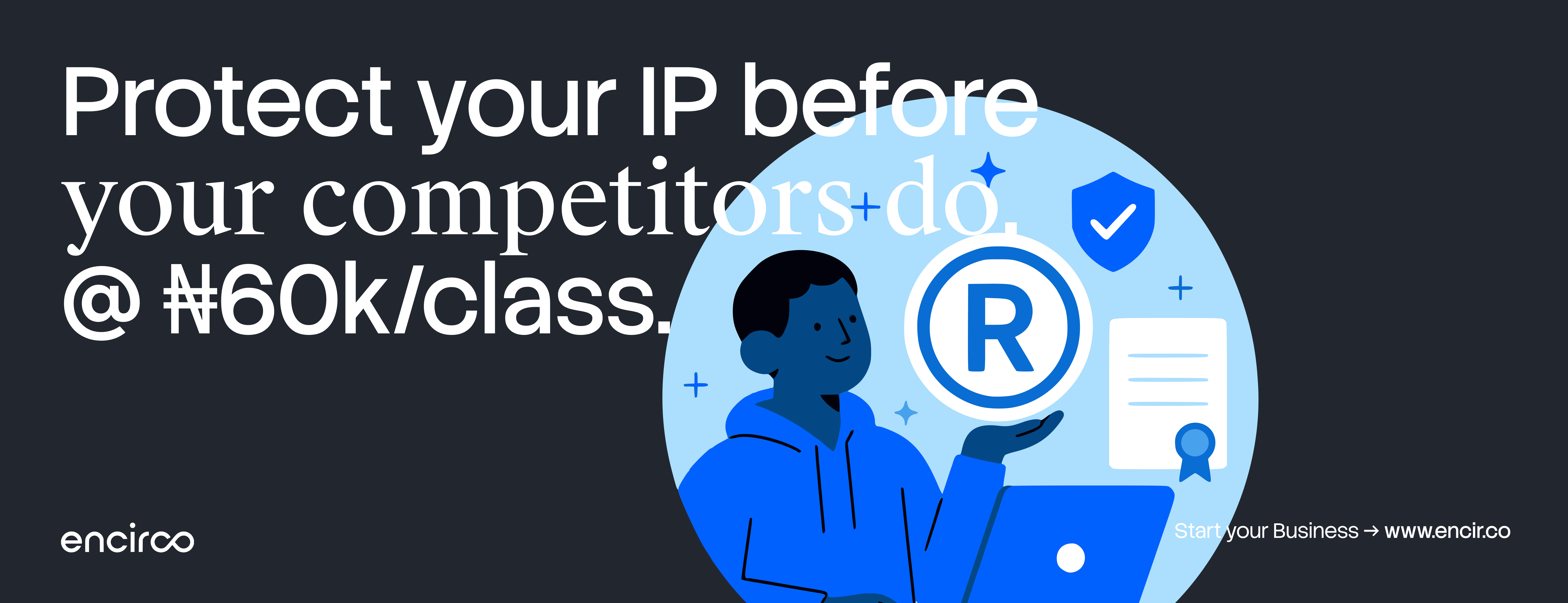
Perhaps the best advice for every entrepreneur is this: don't wait until your brand becomes valuable before protecting it. Protect it because you intend for it to become valuable. We insure assets before they're damaged. We back up important files before they're lost. Intellectual property deserves the same mindset. It's far easier—and often far cheaper—to secure your brand early than to recover it later.
Businesses evolve. Products change. Markets shift. Technology advances. But a trusted brand compounds in value over time. It becomes an asset customers recognize, investors appreciate, and competitors wish they owned. That's why trademarks aren't just legal documents—they're business investments. And for entrepreneurs who are serious about building lasting companies, protecting the brand shouldn't be an afterthought. It should be part of the foundation.
Start your Trademark - www.encir.co



Trusted by 500+ African businesses
A weekly digest of business insights,
compliance updates, and operational guidance.
Get updates on compliance, business tips, and tools to
help you run and grow your company.